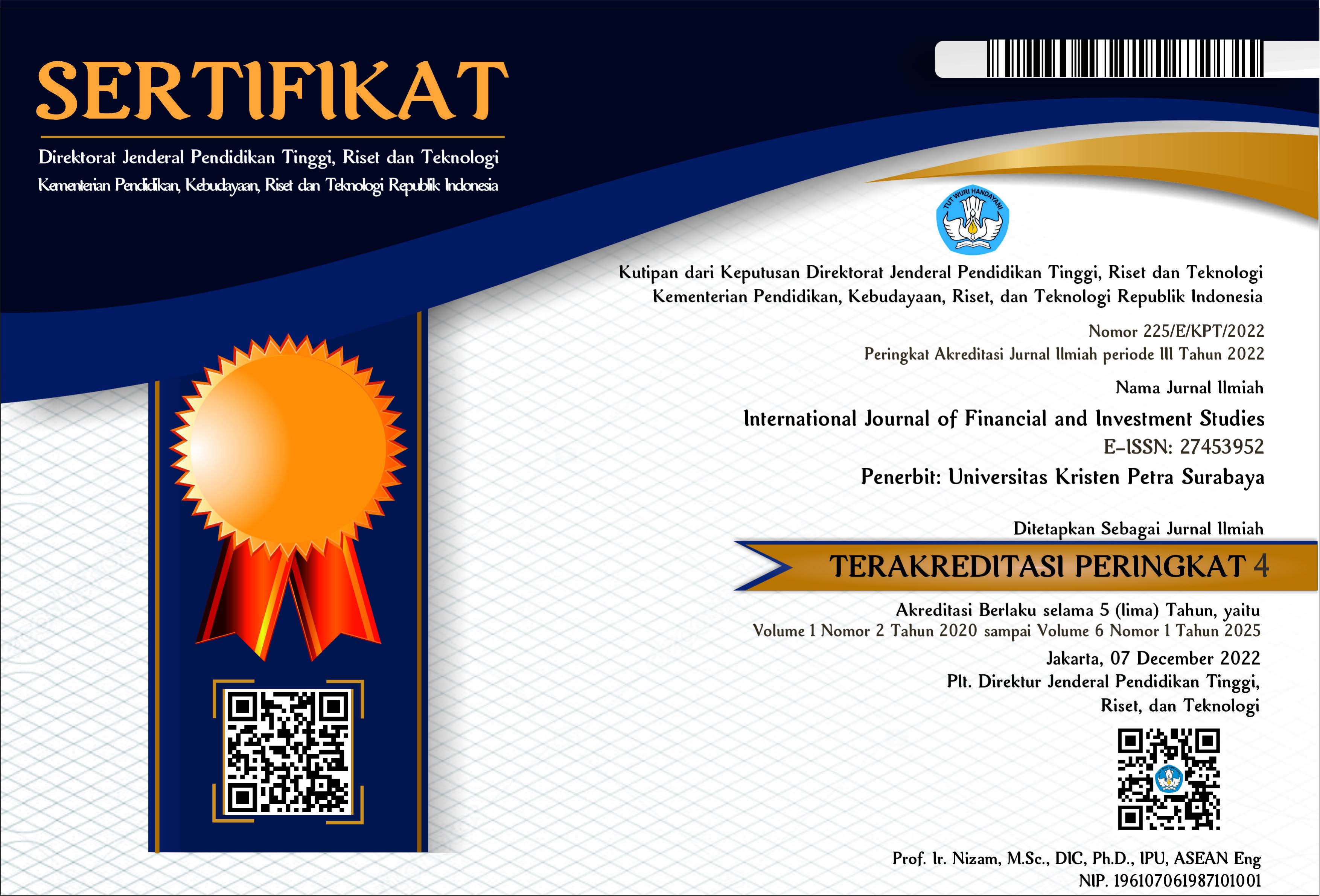
EFFECT OF FINANCIAL LITERACY, RISK ATTITUDE AND SAVING MOTIVES TO DISPOSITION BIAS ON MUTUAL FUNDS INVESTORS
Abstract
Investment is significant to prepare human needs in the future. To make investment decisions, investors will try to make their decisions as rationally as possible. However, one cannot deny that some irrational factors or biases also influence investment decision-making. This study examines financial literacy, risk attitude, and saving motives on disposition bias of mutual fund investors. The sample used is mutual fund investors, and the respondents themselves make decisions to sell or buy mutual funds. The total of respondents is 116 respondents. The regression method used in this study is binary logistic regression using SPSS software. This study found that financial literacy and risk attitude has a significant effect on disposition bias. Meanwhile, the variable saving motives have no considerable impact on disposition bias.
Downloads
References
Charness, G. Gneezy, U., 2007. Strong gender differences in investment. Mimeo
Chowdhury, S. & Endres, M. (2005). Gender difference and the formation of entrepreneurial self-efficacy. Presented at the United States Association of Small Business (USASBE) Annual Conference, Indian Wells, CA.
Dhavaney, S et al (2007). Household Saving Motive, The Journal of Consumer Affairs, Vol. 41. No. 1.pp. 174-186.
Friestad, Marian and Peter Wright (1994), “The Persuasion Knowledge Model: How People Cope with Persuasion Attempts,” Journal of Consumer Research, 21 (June), 1–31.
Grable, J., & Lytton, RH (1999). Financial risk tolerance revisited: The development of a risk assessment instrument. Financial Sendees Review, 8, 163-181.
Harris, CR, Jenkins, M., & Glaser, D. (2006). Gender differences in risk assessment: Why do women take fewer risks than men? Judgment and Decision Making, 1, 48–63.
Hillson DA & Murray-Webster R. 2005. “Understanding and managing risk attitude using applied emotional literacy”. Published by Gower, Aldershot, UK. ISBN 0-566-08627-1 (forthcoming).
Kafayat, A. (2014). Interrelationship of Biases: Effect Investment Decisions Ultimately. Theoretical and Applied Economics XXI 6 (595), 85-110.
Kahneman, D & Tversky, A. (1979). 'Prospect theory: An analysis of decision under risk', Econometrica, vol. 47, no. 2, pp. 263-291. http://dx.doi.org/10.2307/1914185.
Keynes, JM (1936). The general theory of employment, interest and money. London: Macmillan.
Lusardi, A, Olivia S. Mitchell, and Curto, V. 2010. Financial Literacy among the Young. Journal of Consumer Affairs, 44 (2): 358–380.
Mahdzan, NS, & Tabiani, S. (2013). The Impact of Financial Literacy on Individual Saving: An Exploratory Study In The Malaysian Context. Transformations in Business and Economics, 12(1).
Mandell, L. (2008), The Financial Literacy of Young American Adults: Results of the 2008 National Jump $ Tart Coalition Survey of High School Seniors and College Students, The Jump $tart Coalition for Personal Financial Literacy, Washington.
Pompian, Michael M. (2006). Behavioral Finance and Wealth Management. How to Build Optimal Portfolios That Account for Investor Biases. First Edition. New Jersey: John Wiley & Sons, Inc .
Powell, M., & Ansic, D. (1997). Gender differences in risk behaviour in financial decision-making: an experimental analysis. Journal of Economic Psychology, 18, 605 – 628.
Ricciardi, V. & Simon, HK (2000). What is Behavioral Finance? Business, Education and Technology Journal, pp. 1-9.
Wahono, H. K. & Pertiwi, D. (2020). Pengaruh financial literacy, materialism, compulsive buying terhadap propensity to indebtedness. International Journal of Financial and Investment Studies (IJFIS), 1(1), 1-14. https://doi.org/10.9744/ijfis.1.1.1-14
Wärneryd, K. (1999). The psychology of saving. A study of economic psychology. Cheltenham: Edward Elgar Publishing.
Widjaja, R. & Pertiwi, D. (2021). The influence of emotional factors, materialism, risk perception, and financial literacy on the tendency of debt of millennial generation in Surabaya. International Journal of Financial and Investment Studies (IJFIS), 1(2), 85-93. Retrieved from https://ojs.petra.ac.id/ijfis/index.php/ijfis/article/view/57
Authors who publish in this journal agree to the following terms:
- Authors retain unrestricted copyright and full publishing rights. The authors grant the Publisher the right of first publication, with the work simultaneously licensed under the terms and conditions of the Creative Commons Attribution 4.0 International License.
- Authors can enter into separate, additional contractual arrangements for the non-exclusive distribution of the journal's published version of the work (e.g., post it to an institutional repository or publish it in a book), with an acknowledgment of its initial publication in this journal.
- Authors are permitted and encouraged to post their work online (e.g., in institutional repositories or on their website) before and during the submission process, as it can lead to productive exchanges and earlier and more extraordinary citations of published work.